Showing posts with label Airlines. Show all posts

Tuesday, June 20, 2017

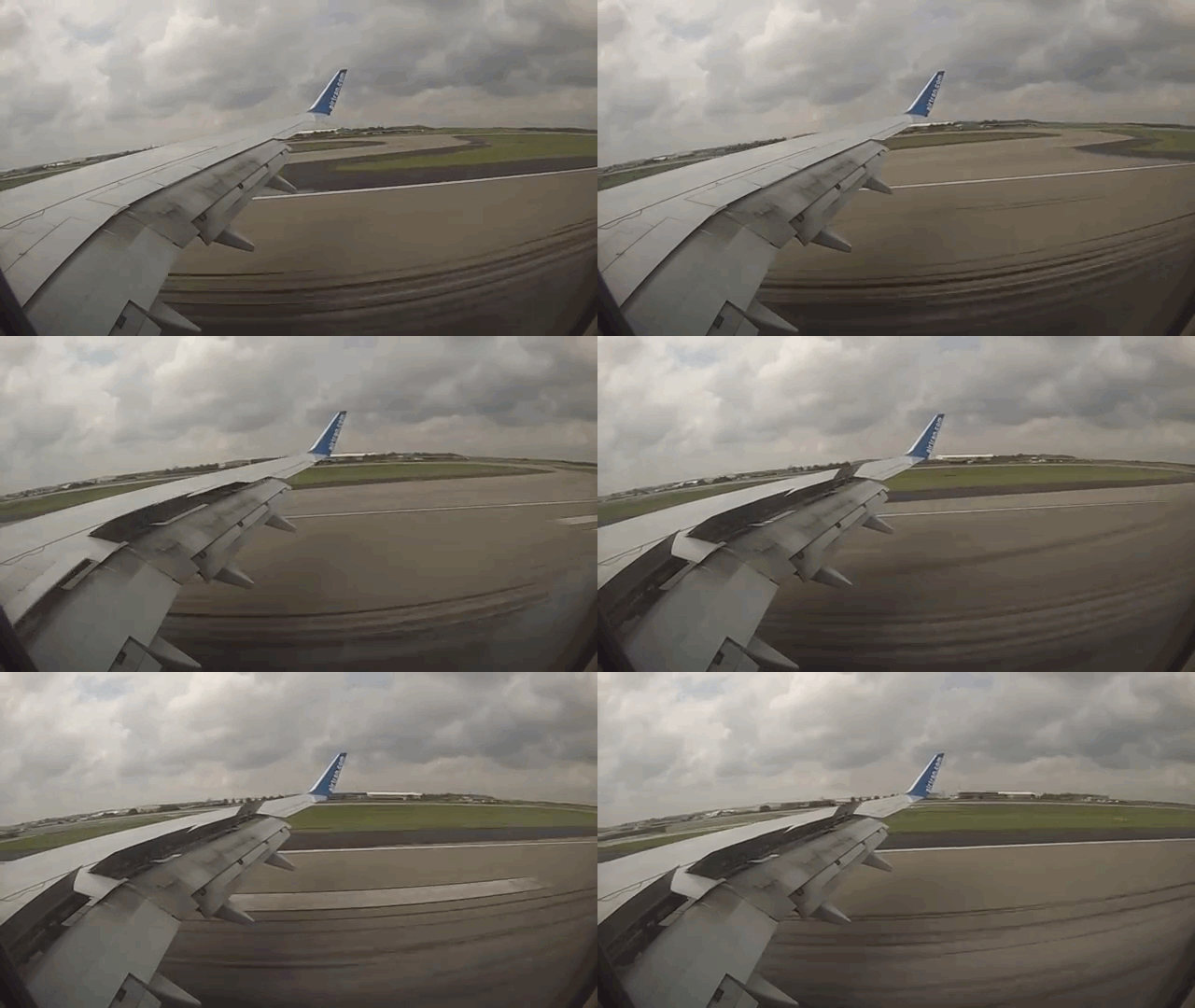
What are spoilers used for on a plane, and when are they used?

There are two category uses of aircraft spoilers, Flight Spoilers and Ground Lift Dumping. It’s easy to figure out which one is used for in flight and which one is for on the ground.
Flight spoilers are merely designed to increase drag and reduce (or dump) lift. All modern airliners are designed to have the least amount of drag from the airframe to increase fuel efficiency and range. Modern jetliners typically have 2 to 8 spoiler panels per wing depending on the size of the jetliner.

Spoilers in flight have several uses to assist the pilot in controlling his/her airplane. When a pilot wants to slow down and/or descend quickly, that low drag design can be a hindrance to doing so. Flight Spoilers (Speed Brakes) give the pilot the ability to increase drag thereby allowing the pilot slow down and/or descend at a faster rate. In flight, the aircraft typically uses one or two spoiler panels per wing.
Another important use of Flight spoilers is roll control and controlling adverse yaw. Spoilers in combination with ailerons help the pilot smoothly control turns to make them more stable and comfortable.
Spoilers on the ground have one specific use, Lift Dumping for Landing roll and aborted takeoffs. The efficient design of an aircraft wing creates lift at all times the aircraft is moving through the air. The faster the plane moves forward, the greater the lift created. This lift, even when the airplane is not airborne, reduces the weight on the wheels. Again, the more lift being created, the less weight on the wheels during landing or takeoff.
This reduced amount of weight on wheels lowers the braking action or effectiveness of the wheel brakes and significantly increases the required length of runway to stop a heavy jet, (up to 200% more runway). Aircraft designers have designed Ground Spoilers for use when landing and aborting takeoff to dramatically reduce landing distance and directional control.
Thomas Zerbarini

Tuesday, April 11, 2017

What's your opinion on United Airlines forcing a passenger to give up his seat?

What's your opinion on United Airlines forcing a passenger to give up his seat?

Answer by Thomas Zerbarini:

Unfortunately, it's an airline industry practice. You'll notice that the airlines with the cheaper fare structures bump the most passengers because the have to push full capacity on the airplane to make up for the lower fares.

Every flight has a history of passenger "no shows." To avoid significant lost revenue the airline tracks flights and determines the average number of passengers that do not show up for the flight. The airline will then consider overbooking seats equevalant to the average no-show amount to fill the airplane. The alternative is non-refundable tickets if you "no show" for your flight. Even if your late and just miss your flight.


I wonder if the airlines will come up with a better way to handle this. Maybe better statistical analysis, designating bump rate tickets, standby tickets, more high price refundable tickets and/or less cheap seats.

As far as the behavior by the passenger and the airport security officer, I believe the behavior was deplorable. It should not have escalated this far. The passenger should have never been boarded in the first place if there was a chance of him or anyone getting bumped. This is a customer service problem that became a security and safety problem that the Captain and crew had to consider.

Since the matter escalated and the passenger refused to follow crew instructions and became adamant in refusing to deplane and cooperate, the passenger has to be considered a safety/security risk for the flight by the Captain.

As captain and crew we absolutely hate these situations. When possible mistakes or poor customer service, weather delays, maintenance delays, over-bookings etc… happen, it can escalate passenger stress and frustrations. I’m certain this incident will be investigated thoroughly and new protocols and staff training will be put in place to mitigate these escalations in the future and hopefully handle over-bookings more efficiently.

Thomas Zerbarini

What's your opinion on United Airlines forcing a passenger to give up his seat?

Thursday, December 29, 2016

Don't be so quick to judgment!

In many high profile industries like sports, aviation and alike there is magnetic appeal to report in the media disparaging blame and judgement of fault or guilt upon the key players, pilots or accused in the matter at question. After all, where's the news unless you can hang someone right?

Well, a pilot in a recent aviation incident felt compelled to voice his dissent in the media, and societies quickness to accuse him as the failure or at fault for the incident/accident that ensued.

Aviation is a strange profession. I love it to death, but the strange part is that if I meet my end in my line of work, it's most likely that I'll be blamed.
I'll be blamed long before any proof is brought forward. I'll be blamed by the media, by the people. I'll be blamed by the passengers if they survive. In a week the data recorders will be analysed and then maybe they'll find that it's not my fault. That I fought for hope amidst hopelessness till my dying breath.
Sadly that won't make as good a headline as much as "pilot error", or "pilot veers off runway when aligning for takeoff".
In fact, it was nothing to do with aligning that brought this ill-fated crew to a halt just short the peripheral wall at Dabolim yesterday (December 27).
How I wish I could explain concepts of asymmetric thrust to the number of people passing silent judgment and being armchair jurors. How do I tell someone about how much thrust 27,000 odd pounds is? How do I reiterate what a reverser unlock is? How do I tell the person that the same 27,000 pounds is now in an opposite direction?
Most of the crowd probably doesn't even know what a moment arm or a couple is. They dropped physics in 8th grade as it was too complex. That said, they blame the human machine who earns his bread and butter, putting into practice what they felt was too complicated.


Jet Airways Goa-Mumbai flight, which skid off the runway on December 27.
To be honest it's disgusting - flying this kind of passenger and taking responsibility for his life for however long it may be.
How do I explain not being able to see three taxiway lights in front of me to a crowd that says, "anyway you autoland in fog"? How?
It's at the brink of frustration that I'm writing this. Back in the day, an old grey instructor told me, "Son, in this world of civil aviation, its best to be a nameless faceless pilot who does his job and goes home!"
I probably didn't understand it then but now, more than ever, I totally understand. The sad part is it doesn't matter if it is a Cactus 1511 with Sully or the 9W aircraft.
Sadly, with technology improving in the home and workplace, the human has become the weak link. Sometimes one must note that the human is the strongest link. Without them shutting down the malfunctioning engine, the plane might have gone into the terminal, increasing the statistics of loss of life
As an appeal to the non-aviation public, believe that we as pilots love what we do and would never put anyone's life in jeopardy. We are sons, daughters, wives, husbands, parents, just like you. We haven't fallen from the realm of Asgard into the helm of these metal ships. It takes years of hard work to achieve it.
Media folk, this is an appeal to you: It's you who have sensationalised our profession with scandals, malpractices, and so on. Paint the right picture of pilots worldwide. Tell people that we are there to save lives, not take them. Make an honest effort to redeem your name when you're standing at heaven's gates, or you'll probably have the boatman remove you from the boat.
Educate the masses - who you manipulate to get more views - to the actual facts of thrust, lift, weight and drag. Tell them, from start to finish, what happens from takeoff to touchdown.
Do tell them that when they see the wind looping out of the window and the tip moving, there is a hand guiding this giant metal bird through the skies.
Stop judging: Pilot of Jet Airways Goa runway crash writes a strong letter

 We see this same quickness to judge in many high profile or sensitive emotional subject including false rap, assault or sexual abuse that can quickly cause hysterical responses to further inflame the false accusation and sensations the rumors, gossip and worst of all press and public opinion.

As a professional pilot and parent of four young children, I witness these types of allegations and false opinions placed upon my peers all the time and its immensely frustrating. Eventually we can get the truth uncovered and the facts laid out for all to see. The damage has been done already, in most cases, when false allegations and disparaging claims are made in knee-jerk haste to capitalize on the media impact or personal attack.

It usually takes years to repair the damage caused by these unsubstantiated quick judgements. Just imagine the irreparable harm it causes to young children as well if they are involved in the blame and shame somehow in domestic situations.

I think this pilots appeals are sound. I believe its a good message and should be expanded towards all areas that require un-biased investigative work and science based facts and findings to get to the real truth(s) before passing judgements. Especially in high profile cases where the media can easily get into the weeds.

Thomas Zerbarini

Also see: Why was Crystal Mangum, in the Duke lacrosse case not prosecuted for false allegations and lying?


Wednesday, October 19, 2016

How do I become a pilot? I am looking forward to becoming one, but I am very lost…please help!

My answer to How do I become a pilot? I am looking forward to becoming one, but I am very lost…please help

Answer by Thomas Zerbarini:

I remember when I was in high school trying to figure out how to become an airline pilot. It all seems so elusive until I started asking questions and digging around like you are doing now.

Let me start off by saying I think your going after a Civil Engineering degree is a great idea. It really doesn't matter what degree you have when you want to become an airline pilot. It does make it easier to master more knowledge of the aviation industry if you get an aviation degree; but, you can study aviation at your leisure. Studying what you love is always easy.

I’ll share with you a previous post that gives links to aviation college resources and aviation flight schools as well. I would recommend visiting several colleges and schools and ask lots of questions. Prepare a folder with questions and a pad to write down you thoughts and observations when visiting.

The main obstacle for most pilot students is the financing and cost of flight training. You will find when you contact the flight schools and colleges that the “lab fees” or “flight training fees” are a big additional cost.

Consider going to a college that offers the civil degree and aviation flight degrees. I recommend this because when you are in college and get you flight training in college, you can use your financial aid and student loans for much of your training costs. Otherwise, you’ll have to self fund all of your flight training.

It is also a good idea to map out you post college and post training goals for gaining experience and your first commercial flying job. As an airline pilot you’ll need 1500 hours of flight time before the airlines can hire you. So, consider being a flight instructor, cargo pilot, bush pilot, etc… Be sure to ask questions on placement assistance and job search for graduates when you go to the schools.

What are the steps of becoming an airline pilot and how much time will it take?

How do I become a pilot?

I hope this helps.

Thomas Zerbarini

How do I become a pilot? I am looking forward to becoming one, but I am very lost…please help

Thursday, July 7, 2016

What do I do between graduating at Embry Riddle and being hired as a professional pilot?

My answer to What do I do between graduating at Embry Riddle and being hired as a professional pilot?

Answer by Thomas Zerbarini:

First of all, being a professional pilot is a mindset, an attitude an approach to how you act and behave as a pilot. So, you are a professional if you act like one. Check out these Code of Ethics I’ve posted on my blog.

Thomas Zerbarini – Code of Ethics

When you graduate you should be seeking to build your flight time and experience. Being an instructor and teaching is one of the best ways to gain knowledge and experience. Also, check out the many charter outfits out there looking for pilots and first officers. Right now, many charter companies are struggling to find enough pilots.

I’d also recommend doing some volunteer work in your spare time. Local community stuff and some aviation interest at a museum or airport too.

Keep your social media professional too. I can’t stress that enough.

It is a great time to get started as a professional pilot. Keep plugging away at gaining good experience and developing a well rounded “you.”

Thomas Zerbarini

What do I do between graduating at Embry Riddle and being hired as a professional pilot?

Tuesday, June 21, 2016

Is there a big demand for pilots as airlines are ordering more aircrafts every year? And will it continue?

There is a huge demand for pilots and it is getting larger year over year. Here are some of the reasons more pilots are needed worldwide:

  • Pilot retirements are increasing.
  • Global air travel is increasing and demand for more available seats are increasing.
  • Years of poor economies, airline bankruptcies, pressures to lower employee costs and eliminate airline employee pensions and retirements has created a “lack of interest” for young folks to consider an lack luster piloting career.
  • Security wait times are still a huge encumbrance for air travel. With screening times averaging around 1–2 hours recently, it is the bottle neck or choke point in passenger convenience and increased travel times.
As we develop faster ways to screen passengers more effectively and efficiently, you will see more people returning to airline flying that are now disgusted with the screening process.

This is one of the best times to be and airline pilot and to consider a career as an airline pilot or any aviation career.

If aviation is your passion then choose a path and a career that will make you happy. If you choose a career that is something you really enjoy and makes you happy; you’ll find that you will excel farther, achieve more and be measurably more successful than if you simply chose a job that you thought would make you more money.

So, choose what makes you happy and you’ll find incredible success along the way.

Thomas Zerbarini

Wednesday, March 2, 2016

How can an arts graduate become a pilot?

Anyone can become a pilot as a career or a hobby.

If a career is what you're after check out the military branches and/or the civilian route with a professional school. If you simply want to be a pilot for your own personal enjoyment/business check out the local small airports for flight schools and/or instructors.

If you want to become an airline pilot, check out one of my previous blog posts on the steps to take:


I had a number of blog post on this subject so look through the history for more information.
If you have anymore questions, don't hesitate to drop me a comment or message via this post.

Thomas Zerbarini


Monday, February 15, 2016

What are the most challenging airports for commercial aircraft?

There are several challenging airports around the world. The Discovery Channel did a nice job in a 1 hour show documenting the top 10 most dangerous airports.

Here is a youtube clip showing some impressive video:


Also, check out this other youtube video: 

 Bush pilots and Jungle pilots probably are the most exposed to strange places to land. Some are on hillsides, some are on river beds, some are in tiny patches of clearing in a dense jungle. Usually, the problem with a landing spot is taking off. It takes more energy and runway to take-off than to land. So, pilots in the Bush don't wan't to get stuck where they can't take off.

 Thomas Zerbarini

  What is the least straight runway that is used for commercial jet aircraft?

Friday, January 22, 2016

Do commercial pilots sometimes forget or not notice if autothrottle is on/off when it should be in the opposite state?

Thinking about Asiana flight 214, and anecdotal evidence of near misses on approach (stall) when autothrottle was believed to be active but was actually off, is it common to misunderstand the state of autothrottle, and is it easy to miss?

Answer by Thomas Zerbarini:


As you can see from your question in reference to the Asiana accident; yes it is possible for pilots to miss something. Although quite rare and unlikely it can happen. With improper training, distractions, complacency or other contributing factors errors are possible. That is why we train and re-train so much. It's why we have multiple pilots, checklists, flows, scans and many other mechanisms to establish checks-and-balances for safety.


Aviation Week did a good article summarizing the NTSB findings which included the main probable cause and the many contributing factors that caused the accident.


With these findings in mind, we can emphasis how important it is for pilots to be diligent and monitor the aircrafts performance and flight path at all times even when the auto-pilot is engaged. Now, professional pilots know this and it is engrained in us. Yet, complacency can be insidious which makes monitoring each other in the cockpit is so important.


Here is an image of a Boeing 777 Cockpit:


At the very top on the glare shield panel in the center is the Mode Control Panel MCP (auto-pilot panel). It looks like this:


On the MCP you'll notice on the left side the A/T (auto-throttle) switch light. This switch light is green when the auto-throttles are engaged. If you read the Aviation Week article I provided above you'll notice that the A/T system was engaged, so the green switch light would be green (on) and if the pilot did a quick scan would see that they were on. Due to the design of the system though, the A/T's were in FLCH "hold mode" and the low speed automatic response was inhibited. Thereby allowing the aircraft speed to deteriorate to a dangerously low speed. The fact that the pilot(s) did not recognize the dangerous low speed nor respond quickly enough is what the NTSB has highlighted as the primary blame for the accident.


Here is a great interactive (click on switches) website that describes the functions of the various controls on the MCP panel:


Thomas Zerbarini

Do commercial pilots sometimes forget or not notice if autothrottle is on/off when it should be in the opposite state?


Thursday, January 14, 2016

What are the steps of becoming an airline pilot and how much time will it take?

Answer by Thomas Zerbarini:
As with any endeavor or education/training required for a professional career, the steps are all similar:
  • Decision/Commitment: Once you've decided to become an airline pilot the next step is to commit to the decision. The reward to any career is your path and the experience you have along the way. I didn't realize this until I began to look back on my career and appreciating all the exciting things I accomplished and learned as I trained and gained my experience. Things like my first lesson, my first solo, my first passenger, my first flight through clouds, my first emergency procedure, my first paying job as a pilot, and so on... Keep the adventure in mind as you navigate through your training and gain your experience.
  • Research: Research colleges and flight schools locally and globally. Compare and contrast all the programs. Pay specific attention to fees, total costs, extras, and the amount of flight time you'll get. Also, ask for "average cost" per student and "average flight time" students of the school require to pass their programs. You'll find that they quote the FAA/ICAO minimums when stated program costs and have a small writing disclaiming that most students require more time. Most of all, get good training and education. If a school mentions employment at the end of your training, get it guaranteed in writing. I've seen countless schools offer employment in their brochures to sell their programs when they only have one or two slots for every 30-40 students going through the program.
  • Setting Goals: Once you've made your decision to pursue your training/education, set and write down your specific goals to accomplish your training. Map your path to success and constantly update your steps and goals as you progress. Remember, your goals are a fluid thing and you'll need to adjust the steps from time to time as you progress to stay on track.
  • Time: Be sure to dedicate the time required to be successful. Becoming an airline pilot can take years. Rarely, it can take just a year or two in some countries with a cadet (Muli-Pilot-License) program or similar.
  • Finances: Like most of us, if you're not one of the lucky few to get a scholarship, you'll have to figure out a way to pay for your education and training. The cost can grow to more than $100,000. So, do your research and calculate your budget.
  • Discipline: Once you make your decision and dedicate yourself, keep disciplined and stay focussed on your goal. Do your best not to get distracted from your timeline. Remember, most airlines base their rosters on seniority. The sooner you land your airline pilot job, the higher your seniority will be. Hence, better pay, schedules, faster upgrades, better vacations, etc...
The path to the airliner cockpit can be difficult and seemingly impossible to achieve. After all, if it was easy everyone would want to do it.
Good luck on your adventure and career..
Thomas Zerbarini
What are the steps of becoming an airline pilot and how much time will it take?

Saturday, December 19, 2015

How much work is it to repaint an airplane?

Answer by Thomas Zerbarini:
As others have pointed out, painting an airplane is very expensive.
What I have found over the last few years is that most airlines used to paint their own aircraft or do it locally. Now I find that it is being outsourced mostly to Mexico. Mexico has less stringent environmental regulation and poor environmental oversight. So, they are dramatically cheaper and faster at stripping and painting aircraft.
I have seen these operations and they do a very good job most of the time. Occasionally we have to send one back for a redo.
Now, painting an aircraft is one thing. Maintenance and inspections is another. There are a number of airlines around the world that outsource their major maintenance to cheaper labor countries. I don't agree with the practice and feel the maintenance should be done at the airline, or at the very least, within the same country the airline and maintenance facility is certificated if the airline has to outsource its major maintenance.
None of the airlines I fly for outsources its maintenance out of the country except Canada where there is a close relationship with the United States. 
Thomas Zerbarini
How much work is it to repaint an airplane?

Friday, December 18, 2015

Are airline pilots basically just good monitors?

Answer by Thomas Zerbarini:
Pilots need to be good monitors/managers of systems; yet, they need to be good aviators too.
The issue that comes to mind when this question is asked revolves around automation and flight automation and aircraft control philosophy.
The two major manfacturers of commercial aircraft (Boeing and Airbus) have completely different philosophy's when it comes to automation:
“Boeing flight decks are designed to provide automation to assist, but not replace, the flight crew member responsible for safe operation of the airplane.” — Boeing
“All aircraft have physical limits that they must not exceed... These limits define the flight envelope, not to be exceeded during normal operation.” —Airbus
Basically, Boeing allows a pilot full flight control authority to meet any need the pilot deems necessary to handle any emergency. Airbus places hard limits and will not allow the pilot to exceed any hard envelope.
Here's an article for a good overview of the philosophy differences between the two manufactures: 
I personally agree with the Boeing philosophy and find that there seems to be issues lately with too much automation. When humans rely on too much automation, there is the possibility for complacency. When automation does something unexpected or misunderstood by the pilots; and, when the other pilot does something unexpected or unknown by the other pilot (AF 447, no side stick feedback.) 
Or the new Airbus A350 that embarrassingly self aborted on a media flight from JFK to Dubai. 
And of course the Boeing 777 crash in San Fransisco where the pilots relied on automation to control their speed and did not realize the auto-throttles were off.
Here is a more complete bullet list of each manufacturers philosophy. I included McDonald Douglas from the 80's even though it is now merged with Boeing.

Airbus' Philosophy on Automation
  • Automation must not reduce overall aircraft reliability; it should enhance aircraft and systems safety, efficiency and economy.
  • Automation must not lead the aircraft out of the safe flight envelope to its full extent, should this be necessary due to extraordinary circumstances.
  • Automation should allow the operator to use the safe flight envelope to its full extent, should this be necessary due to extraordinary circumstances.
  • Within the normal flight envelope, the automation must not work against operator inputs, except when absolutely necessary for safety.
Boeing's Flight Deck Automation Philosophy
  • The pilot is the final authority for the operation of the airplane.
  • Both crew members are ultimately responsible for the safe conduct of the flight.
  • Flight crew tasks, in order of priority, are: safety, passenger comfort, and efficiency.
  • Design for crew operations based on pilot's past training and operational experience.
  • Design systems to be error tolerant.
  • The hierarchy of design alternatives is: simplicity, redundancy, and automation.
  • Apply automation as a tool to aid, not replace, the pilot.
  • Address fundamental human strengths, limitations, and individual differences-for both normal and non-normal operations.
  • Use new technologies and functional capabilities only when:
  • They result in clear and distinct operational or efficiency advantages, and
  • There is no adverse effect to the human-machine interface.
McDonnell-Douglas
  • Uses technology to assist the pilot naturally, while giving the pilot the final authority to override the computer and use skill and experience.
Thomas Zerebarini
Are airline pilots basically just good monitors?

Sunday, November 8, 2015

Can I be hired by a major airline as a pilot without a degree but higher than average amounts of flying experience?

Answer by Thomas Zerbarini:
I would say no at this point. It may change in a few years though. As Tom mentioned, airlines are now in fact using computer based screening for their applications. If you do not have that degree box check in the affirmative, you will not be selected to move to the next step in the selection process. Further, due to numerous equal opportunity lawsuits over the past 10 years, airline HR is not likely going to "bend the rules" or "make exceptions" to the selection standards in order to avoid lawsuits. It can be quite frustrating for many with special skills or experiences that may separate them from the pack. Or, those with bumps in their past that are minimal or minor that are easily explained and understandable once given the opportunity. Thomas Zerbarini
Can I be hired by a major airline as a pilot without a degree but higher than average amounts of flying experience?

Saturday, October 24, 2015

Do you need to take psychometric tests to become an airline pilot?

Answer by Thomas Zerbarini:
The simple answer is maybe.

Pilots are questioned and evaluated by their Medical Examiners overtime they get their medical certification updated. They ask questions and observe your behavior while you are in the office and conversing with the staff.

Also, many airline application/interivew screening includes a psychometric test(s) like the Minnesota Multiphasic Personality Inventory (MMPI) or a derivative that uses data collected by profiling their own pilot group and identifying desirable and undesirable behavior patterns.

The MMPI has its shortcomings when it comes to evaluating individuals for employment screenings. The main problem is that when you are going for a job interview, you want to present yourself in the best light. The MMPI has certain "lie" questions and other questions that you may not be so eager to say in an interview. Things that may be okay for you to discuss with your doctor or therapist you may not be so inclined to share with an potential employer.

Essentially in an employment screening scenario the Psych Testing can produce false negatives for an applicant trying to look his/her best for the employer.

Thomas Zerbarini
Do you need to take psychometric tests to become an airline pilot?

Wednesday, October 7, 2015

Is it possible for an ordinary person, not associated with the air travel industry, to experience a simulated airline emergency evacuation?

Answer by Thomas Zerbarini:
Aircraft manufacturers complete live evacuation simulations when they seek certification for a new aircraft from the FAA or other governing certification agency.

In addition to manufacturer demonstration of evacuation and airline specific demonstrations, there are more computer generated modeling companies that can simulate evacuation(s) with limitless variables considered. For example, they can use several interior designs to determine the fastest evacuation time. They can tweak the design and add/change obstacles and features to better the results. They can also place human factors in the modeling.

Here is a video of a UK company that conducts computer generated studies of evacuations:

https://youtu.be/txnjO7O1aVs?t=18m12s
Of course simulating airliner evacuations comes with the risk of injury. The faster you try to get out the more likely they'll be injuries. Hence, the more emphasis on using computer simulations for most of the testing.

I would recommend reaching out to these software modeling companies, aircraft manufacturers and independent research firms and see if they can help you volunteer your time. Just be careful when you do and watch your head.

Thomas Zerbarini
Is it possible for an ordinary person, not associated with the air travel industry, to experience a simulated airline emergency evacuation?

Wednesday, September 30, 2015

Are airline pilots obsolete?

Answer by Thomas Zerbarini:
The bigger question is will you buy a ticket with an airline that does not use humans in the cockpit to fly the aircraft?


(Boeing 787 Dreamliner)

The technology is there to develop a system reliable enough to replace pilots in airliners. It comes with a cost and can that cost be recoverable with passenger tickets or cargo waybills. Unfortunately, the answer is maybe. I for one, as a professional pilot, do not want to see pilots replaced in the cockpit whatsoever.

There is always a drive for any business (airlines) to find cheaper ways to provide the same product and boost profit. If an airline can replace humans in the cockpit and pay a ground operator to manage the flight, you better believe they are looking into it.

During my tenure as Executive Vice President of ALPA International, I made the statement to the Executive Council that in our lifetime we will see airlines attempt to replace pilots in the cockpit. The first "test" will take place in Cargo aircraft and it will be promoted as an "add-on" safety tool to supplement the pilots. Then they may move to replace the FAA and ICAO required "Relief Pilot". But, will this be socially acceptable?

Why pilotless planes aren’t the answer to preventing air disasters

Now I merely said attempt. I think it is an idea that is in deep thought as I write this today.

Of course my opinion on the subject is biased being an airline pilot, I acknowledge that. You can't ignore the value of having "two" pilots  in the cockpit for safety. The value of cross checking each other and good Crew Resource Management keeps normal human errors in check.

FAA TV: The History of CRM

Further, the adaptability of a good crew to handle any nuance or emergency with efficiency is directly proportional to experience and training. A well trained professional crew is a far better resource in the cockpit than any computer or ground base pilot without any skin in the flight (life on the line.)

I do see the interest and research taking place; I just don't see the viability nor think it would be an acceptable alternative that the public would embrace.

Thomas Zerbarini
Are airline pilots obsolete?

Thursday, September 24, 2015

What is the runway length needed for Antonov 225?

Answer by Thomas Zerbarini:
Tom's got a great answer.

I'm also a very big fan of pulling out the spaghetti charts (performance charts) to confirm my aircrafts capabilities. It's just good piloting to master your aircraft.

Here are some examples of the charts pilots, flight engineers and dispatchers use to calculate performance numbers. We used to do these calculations ourselves before standardized performance manuals and computers. Despite the help from computers, good pilots still keep tinker with the old performance charts to stay proficient in using these charts.


You can google more here to see them better:

b727 performance charts

Thomas Zerbarini
What is the runway length needed for Antonov 225?

Can you eventually become a pilot at a major airline by going to embry riddle?

Answer by Thomas Zerbarini:
Yes, you can eventually become a pilot at a major airline by going to Embry Riddle.

  • Get your degree,
  • Get your pilot certificates and ratings
  • Build your flight time by instructing, banner towing, Alaska flying, charter, etc...
  • Stay out of trouble
  • Follow the rules
  • Have and follow your own personal Code of Ethics,
  • Volunteer your time to good causes from time to time
  • Network, network network.

These are some general goals you should develop yourself as you make your way to the cockpit.

Thomas Zerbarini
Can you eventually become a pilot at a major airline by going to embry riddle?

Wednesday, September 23, 2015

Is flying as an airline pilot dangerous for a living?

Answer by Thomas Zerbarini:
Flying as an airline pilot is in no way dangerous for living. It's more dangerous to drive to work than it is to be at work flying if you can imagine that.

Airlines are a public transportation source dedicated to Safety in a big way.  There is so much focus and awareness in everything we do. We practically live breath and digest safety. With so many checks and balances in place via the FAA, NTSB, Public, Media, ALPA Safety, IFALPA Safety, Airline Operations Management, Fellow Employees, Pilots, and Our own personal oversight. You can begin to see why aviation has become incredibly safe.

The Airline industry oversees safety with the swiss cheese approach. Since there is so much human involvement in what we do, we know mistakes will happen. the swiss cheese approach adopts many layers of checks-and-balances so that mistakes or errors have numerous opportunities to be caught before they get out of hand or cause an accident. Of course it's never 100%, but it gets pretty darn close to 100% Safe.

As you can imagine, the best or most safe operations would be the operations that have the best team concept and safety awareness. That's true for any industry or complex environment.

Flying in an airliner is extremely safe in this day and age.

Thomas Zerbarini
Is flying as an airline pilot dangerous for a living?

Thursday, September 17, 2015

How do airplanes manage to stay straight on the runway during takeoff?

Answer by Thomas Zerbarini:
Most large aircraft have two methods of steering on the ground. For slow speeds and ground maneuvering we use the "tiller". The tiller is a hand control that sends steering commands to the nose wheel. The tiller usually commands approximately 60 to 75 degrees of direction left or right. The second method of steering is the rudder pedals. The rudder pedals have a smaller amount of deflection than the tiller, about 8-12 degrees of deflection left or right.

The rudder pedals also have independent brakes systems for their appropriate side (left brake system for left pedal, right brake system for right brake pedal.) Having independent brake systems allow the pilot to use differential braking to control direction. this can be used as a back up method for on the ground steering if the hydraulics to the nose wheel or other steering electronics failure occurs.


During take-off roll, the tiller is initially used to align the aircraft with the runway centerline. Once aligned, the rudder pedals are used to maintain directional control as the aircraft accelerates during the take-off roll. As airspeed increases, the flight controls become more affective and are used for directional control at higher speeds. Once the aircraft has reached a safe speed for flight (We call it Velocity Rotate or Vr,) the flight controls are the primary method of controlling the aircraft. The pilots will use flight control input to "Rotate" or fly the aircraft off the ground. As a positive rate of climb is established, the landing gear is commanded raised and the nose wheel steering system is deactivated.

Thomas Zerbarini
How do airplanes manage to stay straight on the runway during takeoff?